
How Does Temperature Affect Steel Chains and Components?
Temperature significantly affects the performance and safety of steel chains and lifting components but is often overlooked compared with visible issues like wear or corrosion. Both high and low temperatures influence the mechanical properties of steel, affecting Working Load Limit (WLL), service life, and reliability. Manufacturer guidelines should always be followed when equipment is used outside normal conditions.
Alloy steel lifting chains and fittings, such as AMH’s Gray Classic and CARTEC Grade 100 components, are heat-treated to achieve a balance of strength, hardness, and toughness. When exposed to high temperatures, steel gradually softens, reducing strength and hardness and requiring reductions in WLL. Prolonged exposure to excessive heat can also cause permanent metallurgical changes that cannot be reversed by cooling.
Industry standards, including ASME B30.9 and OSHA 1910.184, state that lifting components should not be used above 400 °F (204 °C) or below –40 °F (–40 °C) without reducing their WLL. Manufacturers should be consulted before using chain slings at or below –40 °F. Chain slings may still be used above 400 °F, but rated load reductions must be applied.
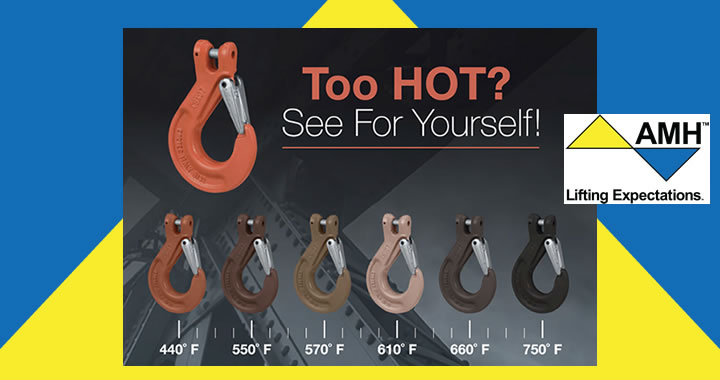
Some components are designed for extended temperature capability. AMH Gray Classic fittings can be used up to 720 °F without WLL reduction and remain suitable down to –40 °F. Drak Master Links and CARTEC Grade 100 fittings maintain full WLL between –40 °F and 400 °F. Above 400 °F, a 10% WLL reduction is recommended from 400 °F to 570 °F and 25% from 570 °F to 720 °F. Operations above 720 °F are generally prohibited due to the risk of severe material degradation. CARTEC hooks also feature a powder-coated finish that changes color when exposed to excessive heat, providing a visual indication of overheating.
Cold environments present different challenges. Lower temperatures can increase steel strength but reduce ductility and increase the risk of brittle fracture, especially under shock loading. AMH chain and fittings perform reliably down to –40 °F; use below this temperature requires further evaluation.
Temperature effects are often invisible but cumulative. Following manufacturer guidelines and selecting high-quality lifting components helps ensure safe, reliable lifting operations. Whenever engaging in overhead lifting operations, always get professional advice from a lifting expert before starting the lift. Follow the manufacturer’s guidelines and select high-quality products from a reliable supplier such as AMH.
“At AMH, we take pride in delivering reliable lifting solutions with a personal touch,” said Peter Brettner, President of AMH. “When customers contact us, they speak directly with knowledgeable, service-driven representatives who understand their applications and respond quickly.”
For more information, www.allmaterialhandling.com.